

Amber: (Creating) Smart Urban Logistics Communities
Ambrosys GmbH is a Saas solutions provider for mobility and energy systems. We operate at the intersection of AI/data science, mobility technology, and urban innovation, with a focus on sophisticated geospatial data processing and system integration. With over 15 years of market experience, the company has built a strong reputation for delivering scalable, flexible, and high‑impact by being a key supplier for Toll Tollect and T-Systems providing both with traffic analysis systems and map-matching components. We're motivated by a simple conviction: smart data science can change the world by bridging silos and offering centralized data integration platforms and intelligent decision-support tools tailored to complex urban environments.
We love digging into difficult problems, and we're genuinely excited when we find elegant solutions. We believe that urban congestion, inefficient parking, and avoidable emissions are solvable when AI-driven insights, real-time data, and community collaboration are combined in a single, scalable platform.
Ambrosys brings together multidisciplinary expertise from mathematics, computer science, engineering, urban planning, and business that help us see problems from multiple angles. This mix creates the kind of creative friction that leads to innovative solutions. This team brings life to projects from smart grid deployment, AI-based traffic decongestion, secure data spaces, virtual testing tools, GNSS-based mobility analytics, and advanced machine learning for near real-time forecasting. Our core expertise lies in extracting actionable intelligence from positioning data. We understand mobility patterns, predict behavior, and design systems that work reliably in real-world conditions.
Ambrosys participates actively in European and national research initiatives, including recent work on secure AI and automotive edge computing under the MANNHEIM-EMDRIVE and Mannheim-Cecas programs. These projects focus on virtual validation environments, on-device intelligence, and the integration of advanced simulation tools with operational datasets. The company’s longstanding involvement in mobility analytics is a strong foundation for the proposed real-world laboratory solution.
We’ve been deeply embedded in Germany's truck tolling infrastructure, working extensively with Toll Collect on multiple projects. This includes operating components of the Stellplatz Informationsdienst, a live system that processes positioning data from truck OBUs to calculate real-time parking occupancy across highway rest areas nationwide. This proves we can derive parking events from GPS traces, handle large-scale geospatial data, and operate privacy-compliant systems under strict regulatory requirements. Furthermore,our work for T-Systems and Toll Collect has taught us to deliver solutions that actually get deployed. We've built our reputation by solving problems that larger consulting firms couldn't crack.
We're thrilled to have this opportunity in the Hauptstadtregion, this is our home, and we care deeply about Berlin's urban future. The "Smart Mobility Communities" concept represents exactly the kind of challenge we love: taking proven technology, applying it to a genuinely difficult urban problem, and creating something that could scale from 100 meters to the entire city. We see the potential for real impact, and that's what gets us out of bed in the morning.
Berlin’s urban transport faces growing environmental, societal, and operational pressures. Population growth, rising commercial activity, and increasing tourism strain existing infrastructure. Whilst road traffic contributes heavily to air pollution, with NO₂ exceedances persisting for decades, while transport-related noise affects millions, generating an estimated €388 billion in external costs annually. Municipalities struggle to internalize these costs due to limited funding and lack of adaptive, real-time traffic management tools. Congestion remains chronic, reducing productivity, increasing emissions, and diminishing quality of life. Conventional parking and logistics systems are static, inefficient, and rarely data-driven, disproportionately affecting underserved communities.
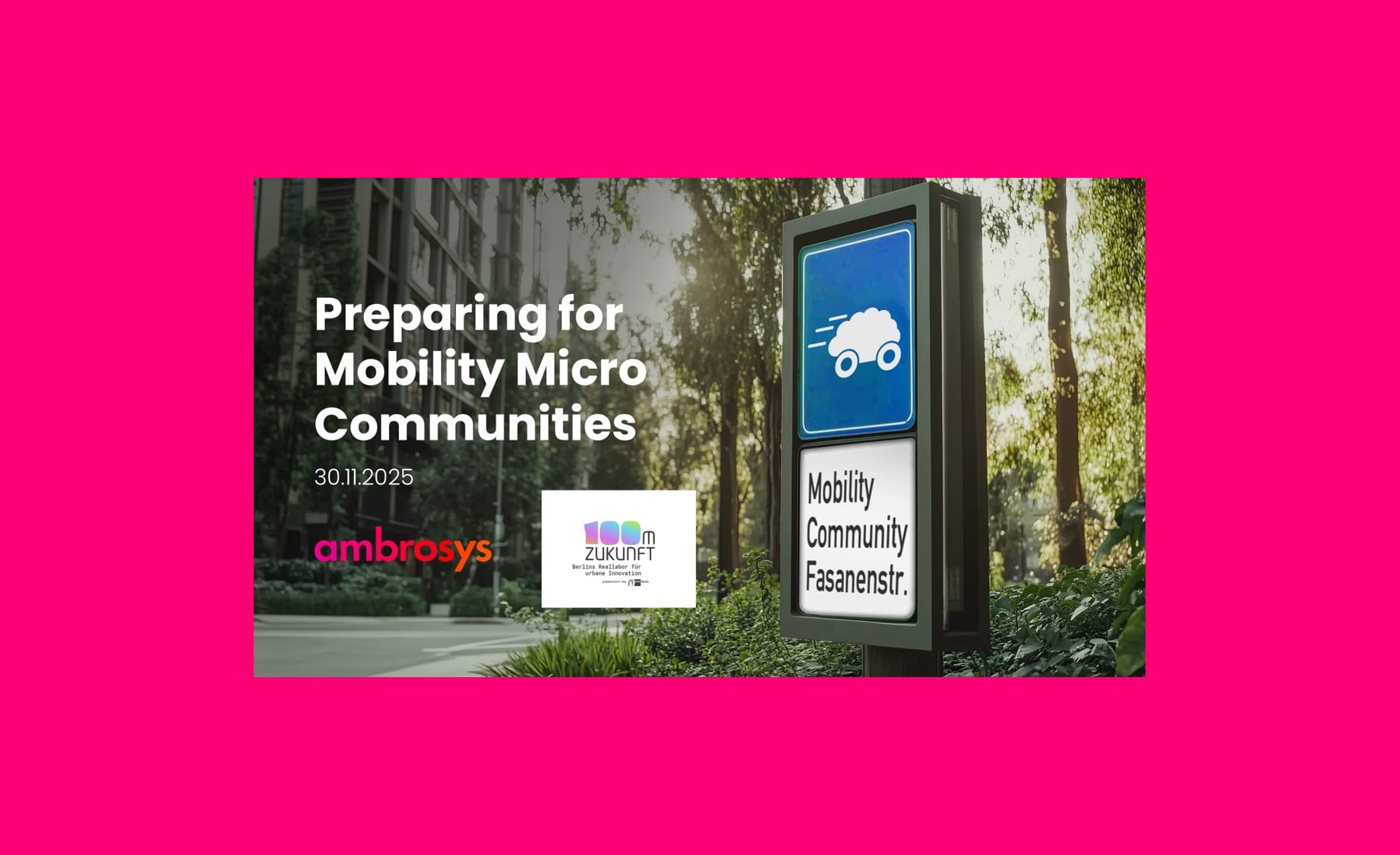
Fasanenstraße in Charlottenburg exemplifies these challenges. Offices, hotels, a medical center, a cinema, a bank, a library, businesses, and residences coexist with limited parking. Despite proximity to Bahnhof Zoo, many rely on cars: employees avoid public transport, visitors distrust sparse evening schedules, and patients may have mobility limitations. Each actor functions as a “mobility island”: garages sit empty while street parking is congested, creating inefficiencies and higher emissions. Must it be this way?
Amber is a privacy-preserving mobile app that predicts real-time parking occupancy using crowdsourced data, on-device computation, and AI-based statistical modeling. Its routing engine provides optimized navigation and, eventually, eco-routing options. The app maximizes existing street parking infrastructure and GNSS data, minimizing additional sensors or invasive monitoring. It supports peer-to-peer parking sharing, integration with local stakeholder infrastructure, and incentivizes adoption through gamification or community rewards. Even low adoption rates suffice for reliable occupancy estimation. Residents benefit from predictive parking information, reducing cruising traffic. Local businesses gain through monetized underused parking, increased foot traffic, and cross-promotional opportunities. Cities receive actionable mobility insights, improved infrastructure utilization, and emissions reduction.
Technical Architecture
Edge Computing: The Amber mobile app processes movement patterns, deceleration signatures, and contextual spatial information locally to detect “parking entry” and “parking exit” events without sending raw location data to external servers. All GNSS data is processed locally to detect parking events without transmitting raw location data. Only pseudonymized events are sent to the backend under user opt-in, preserving privacy.
Optional Secure Cloud Sharing: Users can securely share anonymized GNSS data for more precise predictions. Access can be revoked instantly.
Hybrid Inference Model: Combines partial user data, ground-truth observations, historical patterns, and traffic flow data to estimate full street occupancy, maintaining high accuracy even with low participation.
Implementation in Fasanenstraße
Volunteer residents, commuters, and local businesses provide position data while parking activity is registered. Real-time parking availability can be communicated through several channels: pilot users receive direct indications within the app; non-participating street users can access information via digital signage strategically placed along Fasanenstraße; and third-party applications can integrate the data through dedicated APIs, enabling broader ecosystem engagement. Real-time availability is communicated via the app, digital signage, and APIs for third-party integration.
Our UI/UX validation process combines lightweight qualitative methods such as early prototype walkthroughs and targeted usability tests with quantitative insights from interaction analytics and workflow performance. This enables us to quickly identify friction points in the parking-registration flow, refine how availability information is presented, and validate overall user trust and clarity. Rather than promising exhaustive validation, we emphasize a practical, data-informed process embedded in our agile development cycle, ensuring that each iteration is grounded in real user behavior and the realities of the street.
By starting at a street scale, Amber generates high-resolution data and stakeholder insights, creating empirical value before city-wide deployment. Fasanenstraße serves as a testbed to capture, analyze, and understand user behavior, cooperation patterns, and parking dynamics. The pilot produces three key outcomes: a functioning parking utility, detailed street-level mobility intelligence, and a playbook for scalable mobility communities. Modular separation of the app and backend ensures the system can evolve to more sophisticated mobility services, supporting evidence-based, repeatable scaling across districts and eventually city-wide.
The Amber solution transforms urban mobility in Fasanenstraße by reducing cruising traffic, improving air quality, and optimizing curbside usage, delivering immediate ecological, social, and economic benefits. Parking search traffic, which accounts for 30–40% of congestion in dense urban areas, is minimized through real-time and predictive parking information, allowing residents, visitors, and logistics operators to make informed decisions about where, when, and whether to drive.
Even modest reductions in search time decrease vehicle kilometers traveled, NO₂ and particulate matter emissions, noise, and conflict with pedestrians and cyclists. By making parking availability transparent and predictable, Amber also encourages better planning and modest modal shifts, supporting informed transport choices and laying the foundation for data-driven climate policy. The system builds knowledge infrastructure for Berlin, generating hyperlocal, street-segment-level mobility intelligence that municipal planners can use for evidence-based decisions on parking, street design, low-emission zones, and climate action, while demonstrating a methodology for replicable, scalable urban innovation. Beyond operational efficiency, amber fosters cooperative behavior among previously isolated “mobility islands” by enabling residents, businesses, and institutions to coordinate access, demonstrating that voluntary collaboration can reduce car dependence and expand Berlin’s climate-neutral mobility toolkit.
Transparency and trust are embedded through opt-in participation, local data processing, and clear feedback loops showing users the impact of their contributions, which increases engagement and supports equitable access. Economically, amber enhances the attractiveness of Fasanenstraße as a destination, benefiting retail, hospitality, cultural venues, and services by providing predictable parking and reducing friction, while creating new future monetization opportunities for parking operators and logistics efficiency gains. Socially, the system alleviates stress, saves time, improves accessibility for people with mobility constraints, and strengthens community ties by connecting diverse stakeholders. Physically, decreased cruising traffic opens space for pedestrians, cyclists, and alternative street uses, enhancing safety and creating conditions for future urban redesign.
Environmentally, Amber’s modular architecture allows future extensions, such as eco-routing across districts, which in simulations have demonstrated 22–23% energy savings for heavy-duty vehicles, translating into equivalent CO₂ reductions and supporting Berlin’s climate targets, the EU Green Deal, and UN SDGs 11 and 13. By combining immediate operational improvements with the creation of empirical, data-driven insights, Amber establishes a replicable model for intelligent, privacy-preserving mobility management that improves livability, strengthens local economies, reduces environmental burdens, and enhances the social fabric, ensuring that lessons from Fasanenstraße can be scaled across Berlin and other urban contexts, providing measurable, long-term, and equitable benefits while fostering an innovative urban mobility ecosystem.
In a nutshell, Amber contributes to the livability of cities by transforming urban mobility into a coordinated, sustainable, and user-friendly system. It improves social experiences, supports local economies, reduces environmental burdens, and strengthens the social fabric of neighborhoods.
Since August 2021, we have continuously allocated internal resources and direct expenditures toward the development of the Amber tool. To date, approximately €750,000 has been invested. This figure reflects a multi-year commitment covering personnel, infrastructure, and operational overhead required to progress from early research to a functioning prototype and pre-commercial technical foundation.
The majority of costs have been associated with specialized engineering personnel dedicated to core platform architecture, data-pipeline development, model integration, and security compliance engineering. Development was sustained uninterrupted through mid-2024, including an additional six-month extension of full-time team activity beyond 2024 to finalize stable prototype functionality and conduct internal validation.A significant portion of the budget has also been absorbed by production-grade cloud infrastructure. This includes compute environments for model training and inference testing, managed storage for high volume datasets, and continuous integration/continuous deployment (CI/CD) pipelines. These recurring costs were essential to maintain scalability, reliability, and controlled experimentation during iterative development cycles.
To advance the AMBER tool toward commercialization, we are planning a structured financing strategy that combines grants, innovation challenges, and where appropriate co-funding mechanisms. While the core platform is functional, graduating to TRL 8 requires targeted capital to build additional layers, harden the system for operational deployments, and validate performance through pilot projects. Our roadmap includes the development of modular extensions such as an eco-routing optimization layer which significantly enhance emissions reduction potential when deployed across entire districts or mobility systems. Each incremental layer introduces meaningful technical complexity and additional data-integration requirements, resulting in scaling costs that exceed the capacity of internally funded development alone.
Accordingly, we are actively pursuing non-dilutive financing options, including EU-level grants, climate-tech innovation programs, and challenge-driven funding frameworks. These instruments are well-aligned with our objective to deliver measurable environmental impact and accelerate the tool toward market readiness. External funding will allow us to expand engineering capacity, and conduct large-scale validation studies necessary for full commercialization.
For the upcoming development phase, we estimate a total budget requirement of €83,622, which reflects the minimum investment needed to transition our current functional prototype into a successful deployment and implementation. The budget primarily covers the human capital and operational resources required to carry out the implementation of the system.
Personnel costs (€63,398) represent the largest share of the budget and correspond to the specialized expertise needed to advance the system toward TRL 7–8. This includes:
- Engineering Management for architectural planning, technical risk management, and delivery oversight;
- Product Management for requirements engineering, validation workflows, and ensuring market and stakeholder fit;
- Two Senior Developers responsible for backend optimization, integration of routing and simulation modules, API stabilization, and UI/UX refinements;
- A Senior Data Analyst (AI/ML) tasked with refining the prediction models, improving data pipelines, and validating performance of optimization algorithms.
These roles collectively ensure that both the technical integrity and user-value aspects of the tool advance in parallel.
Direct costs (€3,500) cover essential operational expenditures required to sustain the technical and validation activities during this phase. This includes user-validation sessions with district-level stakeholders and pilot users, which are critical for establishing early feedback loops, verifying usability and functional fit, and mitigating deployment risks before scaling to broader operational environments. Additionally, it includes cloud-infrastructure expenses (AWS), which provide the computational backbone for our development and testing processes. These resources are necessary to run compute-intensive workloads such as model training, graph-based routing calculations, simulation pipelines, and scalable API hosting. The cloud environment ensures that our system can be tested under realistic load scenarios while maintaining the flexibility to iterate rapidly on architecture, algorithms, and performance optimizations.
Overheads (€16,724) are calculated at a standard 25% flat rate over direct and personnel costs, covering administrative support, basic operational liabilities, and organizational compliance efforts.
No subcontracting or equipment purchases are required for this phase, as the core infrastructure and development environment are already in place.
The Amber solution is highly feasible and practical for implementation in a real-world laboratory in the short term. The living lab is located directly in front of the Ludwig Erhard House on Fasanenstraße. Fasanenstraße offers an ideal setting for amber’s real-world laboratory due to its dense urban mix of offices, hotels, a medical center, a cinema, a bank, a library, businesses, and residential units, all with limited parking capacity. Its diversity mirrors typical Berlin streets, providing a microcosm to study mobility behavior and test coordination strategies among residents, visitors, and logistics operators. The location’s existing infrastructure, combined with amber’s ready-to-use mobile app and modular backend digital twin, allows rapid onboarding and immediate service delivery while generating high-resolution mobility data.
The solution is fully transferable to other streets in Berlin, additional districts such as Charlottenburg-Wilmersdorf, and potentially to other cities or regions. Its modular architecture and data-driven approach allow scaling to larger spatial areas, including multiple streets, squares, or district-level networks, provided sufficient pilot users and systematic observations are established to ensure accuracy.
Each deployment builds on the same technical core—user-facing mobile app, privacy-preserving edge processing, and a backend digital twin for system-level modeling enabling rapid adaptation while maintaining performance, privacy, and regulatory compliance. By combining real-time monitoring, predictive analytics, and community-based coordination, amber utilizes spatially predefined areas to deliver immediate services and benefits, while creating a scalable model for long-term urban mobility optimization. This approach ensures the pilot not only demonstrates technical feasibility and practicality but also lays the foundation for expansion, measurable impact, and future integration of additional features or layers as the system scales.
As more users join the system, Amber becomes increasingly valuable and opens opportunities to integrate additional functional layers. For example, once a critical mass of mobility and parking data is collected, eco-routing could be implemented to optimize vehicle paths across streets or districts, reducing emissions and fuel consumption. Similarly, predictive logistics coordination, dynamic pricing for shared parking, or integration with micro-mobility options could be added. This layered approach allows the solution to evolve naturally with user participation, turning the pilot into a scalable platform capable of delivering richer, district- or city-wide mobility and environmental benefits over time. By combining real-time monitoring, predictive analytics, and community-based coordination, amber leverages spatially predefined areas to provide immediate benefits while establishing a scalable, extensible model for long-term urban mobility optimization.